

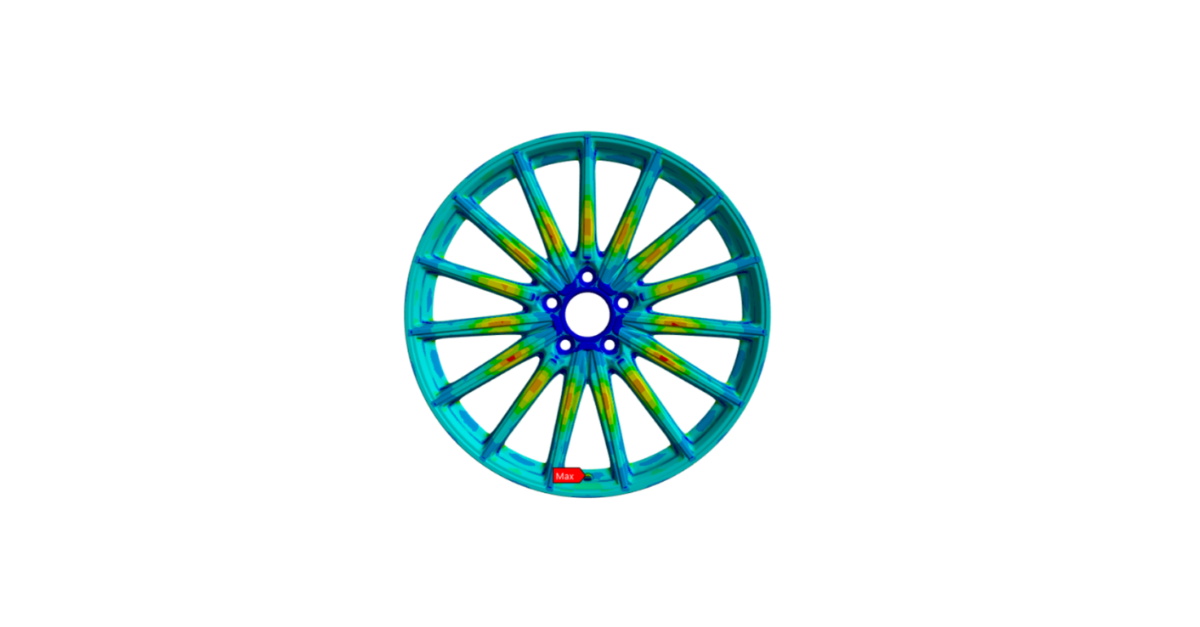
Details:
Technology Used
- Ansys Discovery
- Ansys Mechanical (with custom snippets)
- nCode DesignLife
Objective:
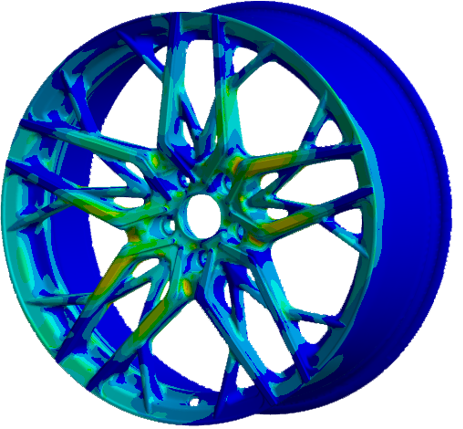
Create validated simulation workflows for radial rolling, cornering fatigue, and impact tests, aligned with industry standards, to optimize aluminum alloy wheel design while providing the customer with robust virtual validation tools for efficient design iteration.
Challenge:
Wheel manufacturers must meet stringent test requirements across multiple loading scenarios while ensuring that material behavior is accurately represented. Traditional approaches often lacked precise material data and produced results inconsistent with physical tests, creating uncertainty in virtual validation and slowing design cycles.
Solution:
Three test-specific workflows were developed for Radial Rolling, Cornering Fatigue, and Impact tests in accordance with ISO 3006:2015 and related standards. Material characterization was performed on specimens from production alloys, generating tensile and strain-life data to inform both linear and non-linear FEA. Structural and fatigue simulations incorporated these material properties, with results validated against physical testing to ensure predictive accuracy. The workflows were implemented in a way that allowed the customer’s engineering team to run them independently, ensuring sustainable internal capabilities for ongoing wheel development.
Conclusion:
A validated simulation framework was established that accurately predicts wheel performance across multiple loading scenarios defined by fatigue and impact standards. This framework reduces reliance on extensive physical prototyping, supports confident design decisions, and enables the customer’s engineering team to perform efficient design optimization with strong correlation between virtual results and real‑world tests.