

Details:
Technologies Used:
- Ansys Discovery
- Rocky
- SPH
Objective:
Evaluate the cleaning efficiency of a chemical dishwasher by analyzing dilution and liquid coverage of contamination on complex surfaces.
Challenge:
Direct measurement inside a dishwasher is difficult due to the harsh environment and limited accessibility for sensors. During operation, droplets of varying sizes form and interact with complex internal geometries.
Traditional CFD approaches such as VOF (Volume of Fluid) require dense meshes and long computation times to accurately capture free-surface breakup and droplet dynamics, making them computationally expensive for this application.
Solution:
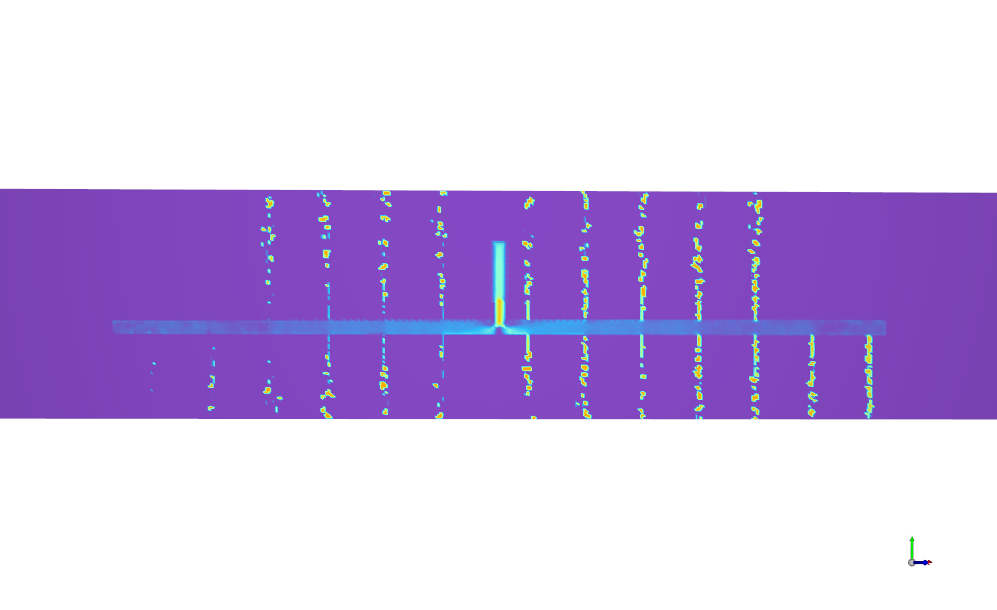
An SPH (Smoothed Particle Hydrodynamics) method was applied to simulate the multiphase flow. As a mesh-free approach, SPH handles free-surface fragmentation and complex solid–fluid interactions efficiently. Using Rocky DEM’s built-in monitoring capabilities, the contact time between liquid and solid surfaces was tracked to evaluate cleaning effectiveness. Leveraging GPU acceleration, simulations were performed with high resolution and significantly reduced computation time.
Conclusion:
The developed simulation approach enabled detailed assessment of liquid coverage and dilution on all relevant surfaces. Based on the results, the company was able to optimize operating parameters of the dishwasher, ensuring a safe and sufficient level of dilution across the entire system while improving process efficiency.